Overview
When you’re trying to start a family and things aren’t working out as expected, it’s natural to feel confused, overwhelmed, and even a little scared. Many couples reach a point where they must decide between two popular fertility treatments, which are IUI vs IVF.
Both offer hope but work in different ways, with different costs, success rates, and timelines. Understanding these differences can make your journey less stressful and help you choose the treatment that truly matches your body, your budget, and your dreams of becoming parents. This guide will walk you through the difference between IUI and IVF and what is best for you.
Understanding the Meaning of IUI vs IVF for Infertility Treatment
When couples face infertility, two of the most common fertility treatments they hear about are IUI (Intrauterine Insemination) and IVF (In Vitro Fertilisation).
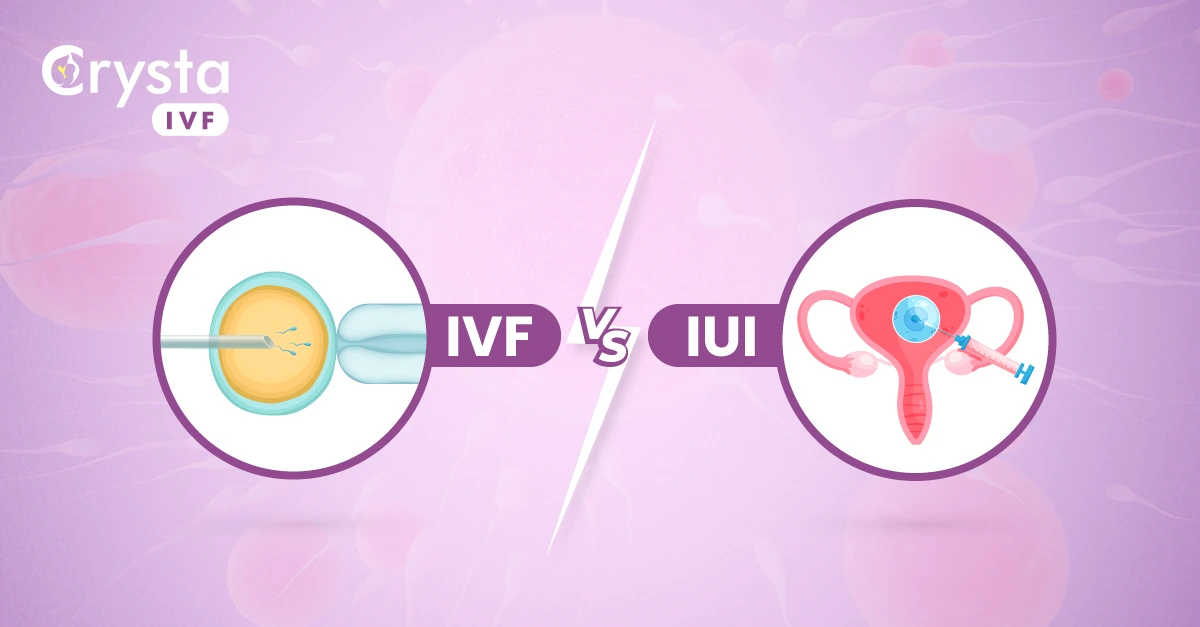
- IUI Treatment: In this procedure, a single cleaned sperm is directly placed into the uterus at the time of ovulation. IUI is less invasive, relatively simple, and often the first step when fertility issues are mild.
- IVF Treatment: On the other hand, IVF is more complex, in which the eggs are retrieved from the ovaries, fertilised in a lab, and then implanted back into the uterus. While IVF usually has higher success rates, it also requires more time, medications, and cost.

IUI vs IVF: Know the Key Differences
Choosing between IUI and IVF can feel confusing, especially when you’re already stressed about fertility. Both treatments aim to help you conceive, but they work very differently and suit different medical conditions.
Below is a clear comparison to help you understand how IUI and IVF differ in terms of process, cost, success rate, and suitability.
| Factor | IUI (Intrauterine Insemination) | IVF (In Vitro Fertilisation) |
| How does it work? | In IUI, the sperm are washed, the healthiest sperm is picked and placed directly into the uterus during ovulation. | In IVF, eggs are retrieved, fertilised with sperm in a lab, and embryos are transferred back into the uterus. |
| Best Suited For | IUI is recommended for mild male infertility, unexplained infertility, ovulation issues, and cervical problems. | IVF is recommended for blocked tubes, severe male infertility, low ovarian reserve, endometriosis, and repeated IUI failure. |
| Procedure Complexity | The IUI procedure is simple, quick, and minimally invasive. It is often done without anaesthesia. | The IVF procedure is more advanced and involves injections, egg retrieval, and lab fertilisation. |
| Success Rate* | IUI success rate varies between 10 – 20% per cycle (varies by age & cause of infertility). | The IVF success varies between 40 – 60% per cycle (varies by age, egg quality & clinic expertise). |
| Cost in India* (Approx.) | The cost of IUI is around ₹10,000 – ₹25,000 per cycle. | The cost of IVF is approximately ₹1.2 lakh – ₹2.5 lakh per cycle (may increase with advanced add-ons). |
| Time Required | IUI requires one natural/medicated cycle and minimal follow-ups. | IVF needs 4 to 6 weeks of time, which includes stimulation, retrieval, fertilisation, and embryo transfer. |
| Who Should Prefer This? | Couples trying for the first treatment step or those needing a budget-friendly option must consider IUI. | Couples with complex fertility issues or who need higher success chances quickly must consider IVF treatment. |
IUI vs IVF: Which is Better for Pregnancy?
There is no best treatment out of both, but IVF generally offers a higher pregnancy success rate than IUI, especially for couples facing moderate to severe infertility issues.
A clinical study on IUI and IVF among infertile women found that IVF led to significantly higher pregnancy and live birth rates than IUI. However, the success rate depends on person to person and is recommended only based on the cause of the infertility problem.
In short:
Choose IUI if you have mild infertility and want a budget-friendly first step.
Choose IVF if you’re older than 35, have blocked tubes, low AMH, severe male infertility, endometriosis, or failed multiple IUIs. But always consult with a fertility specialist before making any decision.
What Expert Advice on How to Decide Between IUI and IVF
“The choice between IUI and IVF should always be based on medical diagnosis, age, and the urgency to conceive and not on guesswork or assumptions. Both treatments have their own strengths, but they work best for different situations.
IUI is typically recommended as the first-line treatment when infertility issues are mild and IVF is advised when the chances of pregnancy with IUI are naturally low.”
However, consider these steps to decide:
- Get a Complete Fertility Evaluation
- Understand the Root Cause of Infertility
- Consider Your Age and Time Sensitivity
- Compare Success Rates Based on Your Condition
- Review Your Medical History and Previous Treatment Failures
- Discuss Treatment Expectations and Comfort Level
~ Senior IVF Specialist at Crysta IVF Lucknow reveals that IVF helps to overcome infertility in extreme conditions.
Difference Between IUI and IVF: Explained in Detail
IVF and IUI are both effective ways of infertility treatment. However, their use case varies based on the couple’s conditions and the cause of infertility. Here are some detailed explanations to decide between the two.
When Should You Choose IUI Over IVF?
IUI is one of the first options doctors recommend for infertility treatment. It involves placing the washed sperm directly in the woman’s uterus during ovulation or, say, the fertile window. IUI is possible to conduct more naturally and with minimal invasion.
IUI is usually helpful for:
- Blocked Fallopian Tubes
- Erectile Dysfunction
- Lower Sperm Motility, and
- Other Causes of Infertility.
On the contrary, the doctors consider In Vitro Fertilisation or IVF when IUI does not offer the desired results. It is one of the treatment plans helpful for unexplained infertility. IVF finds its use for:
- To stop the transfer of genetic disorders
- More complex male or female infertility
- Lower ovarian reserve
- Higher age
- Multiple Miscarriages and more
IVF is a solution to infertility in almost all conditions. However, it is more invasive and less natural compared to IUI.
IUI Cost is Lower:
IUI Vs. IVF Price has a significant difference. Compared to IVF, IUI is a low-cost infertility treatment.
IUI is artificial sperm insemination, which may or may not require the regular consumption of medications. The experts recommend a minimum of three IUI cycles before shifting to IVF.
On the other hand, IVF is a multiple-step process involving egg retrieval, sperm collection, artificial fertilisation, embryo culture, embryo transfer, and cryopreservation.
It is primarily an 8 to 12-day process and thus enhances treatment costs. The overall price of IVF treatment depends on the number of IVF cycles.
In IUI, Fertilisation In The Womb Itself:
In the IVF process, fertilisation occurs in the laboratory under complete assistance, while in IUI, fertilisation and embryo formation occur inside the uterus itself.
Unlike IVF, there is no elective embryo transfer in the IUI process. The embryo is transplanted into the uterus lining after the desired growth during IVF. The doctors might opt for multiple embryo placement or freeze the embryos for future IVF cycles, which is not the case in an IUI process.
IVF Has a Higher Success Rate Than IUI:
One of the most important differences to consider between the two infertility treatments is the IUI and IVF Success Rates, precisely above 35 years.
For women between 38 to 40 years, the IUI success rate is 7%, while the IVF success rate is approximately 26%. Also, for those above 40, IVF has a higher success rate than IUI. IVF has an approximately 8% success rate, which is double compared to IUI’s 4% success rate for women above 40 years.
In short, for any age group, IVF is more successful than IUI. So, if you pay more, you can expect better results too.
When Is IVF a Better Option Than IUI?
IUI primarily beats infertility only in two common ways, as detailed below.
- By improving the egg and ovulation quality
- Increase the number of sperm that contact the ovaries. Nearly 1000x high-quality sperm reach the egg, improving the chances of pregnancy.
IVF beats infertility in almost all the possible ways described below.
- Enhancing the ovulation rate
- Solving the infertility problem due to tubal issues
- With ICSI IVF, it’s possible to inject a healthy sperm directly into the egg; even a single high-quality sperm can fertilise ovaries
- Medicines, along with IVF, can easily increase the uterine receptivity
- IVF injections and medications can help stimulate several eggs even before the cycle completion
- Through reproductive immunology and genetic testing, IVF helps reduce the chances of miscarriage
- Elective IVF improves the success rate of pregnancies, sex selection and even increases the chances of multiple pregnancies
In short, a comparison of IVF and IUI reveals that IVF helps to overcome infertility in extreme conditions.
Is IUI better than IVF for First-Time Treatment?
For many couples starting their fertility journey, IUI is often considered the preferred first-line treatment, but this depends entirely on your medical condition.
From a clinical point of view, IUI is usually suggested first when fertility issues are mild, because it is simpler, less invasive, more affordable, and requires fewer medications. It’s a good starting point if you have minor sperm issues, irregular ovulation, or unexplained infertility.
However, IUI is not always the best first option. If you’re above 35, have low AMH, blocked fallopian tubes, severe male infertility, endometriosis, or have been trying for many years, experts recommend skipping IUI and moving straight to IVF.
IVF offers much higher success rates per cycle and works better for complex fertility challenges.
Final Words
IUI and IVF are both safe procedures to treat infertility and have reasonable success rates. However, the doctors will prefer IUI only when the couple fulfils the IUI requirements like working ovaries, viable eggs, 5-10 high-quality sperms, and regular fallopian tubes.
If you have the desired results in diagnosis, the doctors will initiate with IUI or else will recommend undergoing IVF. Also, if IUI does not give positive pregnancy results in the first three cycles, they will prefer IVF to treat infertility.
Crysta IVF is one of the Top IVF Centre in India, offering the most customised treatment plan. If you are facing any issues in conception, book your free consultation with Crysta’s fertility specialists, who have over two decades of experience.

Stay Tuned For More Updates. We Are Trying Our Best to Answer Queries & Confusions of Couples Struggling with Pregnancy.