

Pregnancy brings a lot of questions, especially if you’re suspecting twins. One of the things your doctor may examine during the early pregnancy days is hCG. It is a hormone that supports the growth of your baby and the uterine lining.
In twin pregnancies, hCG levels are often higher than in general pregnancies, but the numbers can vary for every woman. Understanding your hCG levels for twins pregnancy can give you a better idea of how your pregnancy is progressing and what these levels may mean for you and your little ones.
What is hCG Hormone?
hCG, or Human Chorionic Gonadotropin, is a hormone that your body starts making soon after your pregnancy begins. Once the fertilised egg is attached to the uterus, hCG helps in supporting the early growth of the foetus (baby) during pregnancy. This hormone tells your body to continue producing progesterone, which is important to keep the uterine lining healthy.
You can usually first learn about hCG through a pregnancy test. Home pregnancy kits and blood tests both help in checking this hormone. As pregnancy progresses, hCG levels rise in the first few weeks.
Normal hCG Levels in Early Pregnancy (Singleton)
After implantation, your body begins producing hCG, and the levels usually increase every few days. This rise helps support the pregnancy during the first few weeks.
Most doctors look at how fast hCG levels are increasing rather than focusing on one single number. In many cases, hCG levels double every 48 to 72 hours during early pregnancy. This pattern often suggests that the pregnancy is progressing well.
However, it’s important to understand that “normal” hCG levels can vary widely from one person to another. Two women at the same stage of pregnancy may have very different hCG numbers, and both can still have healthy pregnancies.
Below is a general reference range for hCG levels in early pregnancy:
| Weeks of Pregnancy | hCG Level Range (mIU/mL) |
|---|---|
| 3 weeks | 5 – 50 |
| 4 weeks | 5 – 426 |
| 5 weeks | 18 – 7,340 |
| 6 weeks | 1,080 – 56,500 |
| 7 – 8 weeks | 7,650 – 229,000 |
| 9 – 12 weeks | 25,700 – 288,000 |
Source:
hCG Hormone
Note: hCG values are approximate and may vary from person to person.
Are hCG Levels Higher in Twin Pregnancies?
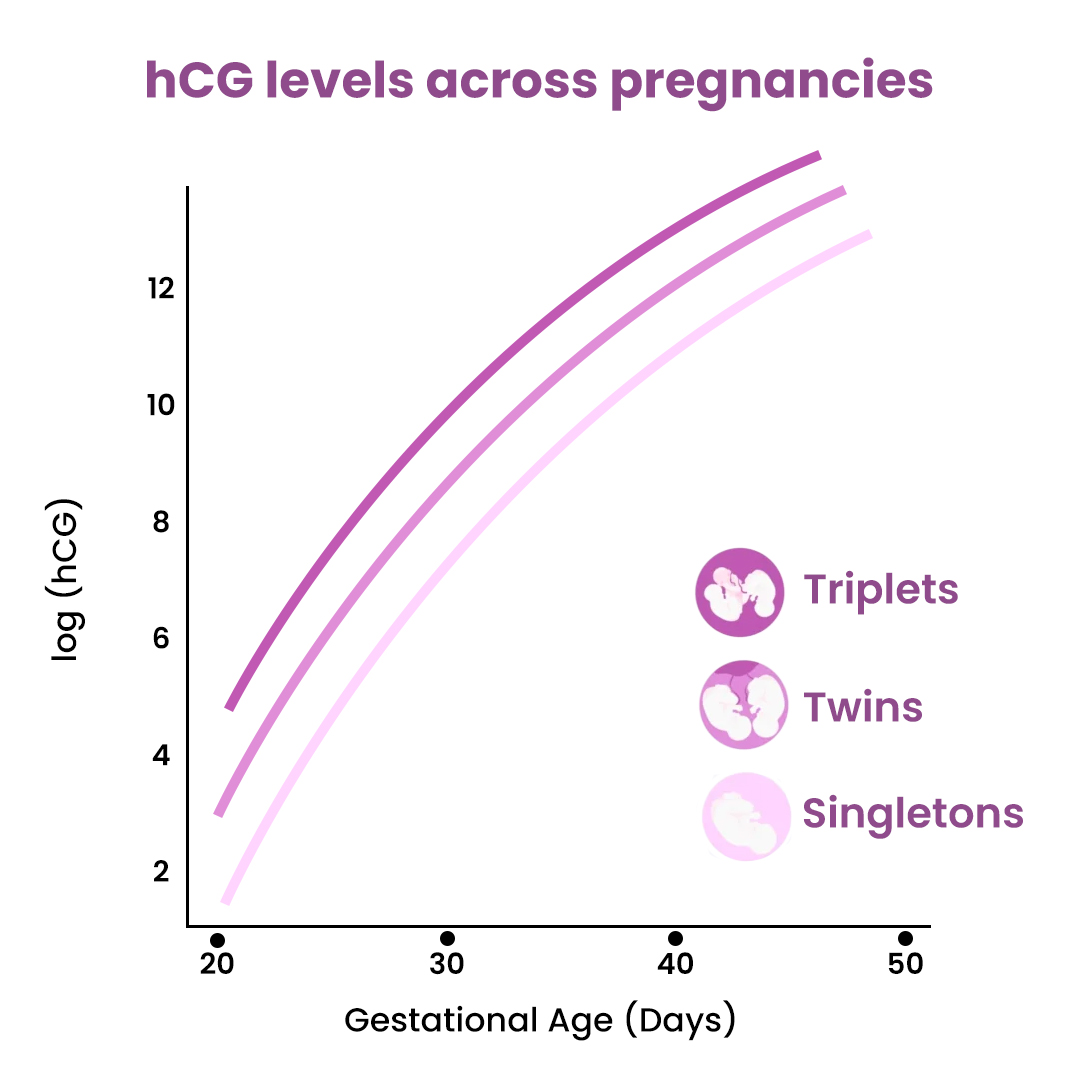
Yes, hCG levels are usually higher in twin pregnancies, especially in early weeks. This happens because the body is supporting more than one developing baby and hence more hCG hormone is produced.
In many twin pregnancies, hCG levels may be 30–50% higher than in a single (singleton) pregnancy at the same stage. Because of this, some women notice stronger pregnancy symptoms like nausea, vomiting, or extreme tiredness.
However, it’s important to understand that high hCG does not automatically mean twins. hCG levels can vary from person to person. Some single pregnancies can also show high hCG levels, while some twin pregnancies may even fall within the normal range.
Normal hCG Level for Twin Pregnancy
There is no separate hCG chart for twin pregnancies, but twin pregnancies show slightly higher values above the normal range. Generally, twin pregnancy hCG levels are often 30–50% higher than singleton levels
Below is a chart to help understand the normal hcG level for twin pregnancy:
| Weeks of Pregnancy | Expected hCG Range in Twin Pregnancy* |
|---|---|
| 3 weeks | 10 – 75 |
| 4 weeks | 200 – 600 |
| 5 weeks | 1,500 – 10,000+ |
| 6 weeks | 3,000 – 80,000+ |
| 7–8 weeks | 15,000 – 300,000+ |
| 9–12 weeks | 50,000 – 350,000+ |
Source:
Twins hCG
Level
Note: Twin pregnancy values are approximate and may vary from person to person.
What is the Difference Between Twin HCG Levels vs. Singleton Levels?
As discussed, hCG levels tend to be higher in twin pregnancies compared to singleton pregnancies during the early weeks. This happens because more placental tissue is producing the hormone. However, the difference is not predictable for every pregnancy.
Many women with twin pregnancies have hCG levels that are on the higher side of the normal range, while some may go slightly above it.
Below is a comparison chart to help understand how hCG levels may differ.
| Days Post Transfer (DPT) | Singleton Pregnancy (mIU/mL) | Twin Pregnancy (mIU/mL) |
|---|---|---|
| 9 – 11 DPT | 50 – 200 | 200 – 600+ |
| 14 DPT | 100 – 750 | 300 – 1,500+ |
| 21 DPT | 1,000 – 5,000 | 3,000 – 10,000+ |
Note: This table is only for general reference, especially for IVF and embryo transfer cases. hCG levels can vary widely from person to person and cycle to cycle.
Can High hCG Confirm Twin Pregnancy?
No, high hCG levels alone cannot confirm a twin pregnancy. While it’s true that hCG levels are higher in twin pregnancies but the numbers overlap a lot with singleton pregnancies. Many women carrying one baby can also have high hCG in early pregnancy, especially in early weeks.
High hCG may happen because:
- Implantation happened earlier than the expected date
- The placenta is producing hormones strongly for the womb
- There is a normal variation from person to person
What High hCG Levels Mean After IVF?
After IVF, seeing a high hCG level can feel both exciting and confusing. Many people immediately think of twins, but after IVF, the hCG numbers can mean something different.
- Successful Implantation – A higher hCG indicates that the embryo has implanted well for the baby and the pregnancy hormone is rising as expected.
- Possibility of Multiple Implantations – If more than one embryo has implanted in the mother, hCG levels may be higher. This can happen in double embryo transfers, but hCG alone still cannot confirm twins.
- Early Testing After Embryo Transfer – hCG may appear high if the test is done a little earlier than the actual implantation day, making the pregnancy look more advanced.
- Strong Placental Hormone Production – Some pregnancies naturally produce more hCG. However, if they are too abnormal, there might be some chances of tumours. This is generally uncommon after undergoing IVF.
At Crysta IVF, we can help you understand every hormone reading, every test, and every symptom. We are here to guide you with care, expertise, and reassurance, making sure you and your baby are safe at every step of your IVF journey.

Do IVF Pregnancies Affect hCG Levels?
No, IVF pregnancies do not directly affect the hCG level. However, the level can be slightly different compared to natural pregnancies. Here is how IVF can change the hCG range for a twin pregnancy:
- hCG is measured based on embryo transfer timing in IVF: In IVF, doctors know the exact day of embryo transfer. Because of this, hCG testing is done on fixed days, which is generally between 9 and 14 days post transfer (DPT). This makes hCG results appear more precise, but it also means small differences in implantation timing can change the numbers.
- IVF pregnancies may show higher early hCG levels: Many IVF pregnancies show higher hCG levels in the early days, especially when there are multiple embryos transferred to the mother, implantation happens earlier than the expected timing or the placenta is producing hormones very strongly.
- hCG trigger shots can cause confusion (early days): Some women undergoing IVF use an hCG trigger injection. And, during such a case, if the hCG is tested early, a part of the hormone detected may come from the injection.
- Doubling pattern matters more than the number: In IVF pregnancies, the Best IVF Doctors in Delhi focus more on hCG rising every 48 – 72 hours, a consistent upward trend, and matching ultrasound findings. A single high number of hCG is not used to make any decisions.
- Ultrasound becomes the main tool after 6 – 7 weeks: Just like natural pregnancies, once the pregnancy reaches 6 to 7 weeks, an ultrasound gives clearer answers about the number of embryos, heartbeats in the mother’s womb, and the growth of the baby. At this stage, hCG testing usually becomes less important.
Tips to Monitor hCG Levels During Twin Pregnancy
During a twin pregnancy, monitoring hCG levels helps fertility doctors understand how the pregnancy is progressing. The goal is not to get a perfect number as per the chart, but to check whether the hormone is rising in a healthy pattern.
Here are some tips to check hCG levels during a twin pregnancy to avoid any unnecessary stress:
- Get hCG tests done only on the date advised by your doctor. This date is 48 hours after implantation. Also, testing too often can cause confusion.
- Focus on whether hCG levels are rising in a pattern. Do not compare one value with charts or other mothers’ reports.
- Avoid comparing your hCG levels with online data, friends, or social media posts, as hCG levels can range widely between twin and singleton pregnancies.
- After 6 – 7 weeks, trust more in ultrasound scans than blood tests to confirm heartbeats, the number of sacs, and growth.
- Pay attention to symptoms like nausea or fatigue, but remember that symptoms alone do not reflect hCG health or pregnancy outcome.
What Are Other Signs You Might Be Having Twins?
Apart from hCG levels, there are a few early signs that may raise the chances of a twin pregnancy. These signs are not confirmed, but you can predict twin pregnancy through these symptoms in the first trimester.
- High-intensity pregnancy symptoms, such as severe nausea, vomiting, or extreme tiredness, may occur due to higher hormone levels.
- Rapid belly growth or feeling “bigger than expected” early in pregnancy can sometimes be noticed.
- You might experience a higher weight gain than usual in the first trimester, but this varies from person to person.
- You may also observe stronger and earlier baby movements than what is generally expected.
- Ultrasound findings such as two gestational sacs or heartbeats are the only reliable way to confirm a twin pregnancy.
Conclusion
hCG levels in twin pregnancies are often higher than in singleton pregnancies, especially in the early weeks, but they can vary from person to person. A higher number may raise the chances of twins, but it cannot confirm a twin pregnancy on its own.
In IVF pregnancies, what matters most is the pattern of hCG rise. It steadily increases every 48 to 72 hours, which is followed by an ultrasound scan (after 6–7 weeks) to confirm the number of embryos and proper growth.
At Crysta IVF, our experts closely monitor hCG trends and provide personalised guidance to ensure both you and your baby are safe. Our doctors guide you correctly with the hCG level and how to know if you are pregnant with twins. You can book a First FREE consultation with our expert doctors directly at +918938935353.