
The era of technology and its contribution to healthcare have benefited numerous people, especially infertile couples. Now, assisted reproductive technologies have revolutionized how couples overcome fertility complications, offering a ray of hope and possibilities where they once felt scarce.
Among these, sperm washing techniques have emerged as a crucial step in the process, improving the likelihood of successful conception. In this blog, we will delve into the science behind sperm washing techniques, exploring their benefits, methods, and applications in assisted reproduction.
Sperm washing techniques: A comprehensive exploration
Along with spermatozoa, semen comprises prostatic and seminal vesicular secretions and contains leukocytes, epithelial cells, and infectious agents like bacteria, viruses, etc.
When a large percentage of semen comes into contact with the uterus, it may lead to painful uterine contractions. While containing certain factors, semen can obstruct essential sperm functions such as the ability to undergo capacitation, acrosome reaction, penetrate zona pellucida, and fertilize the oocyte.
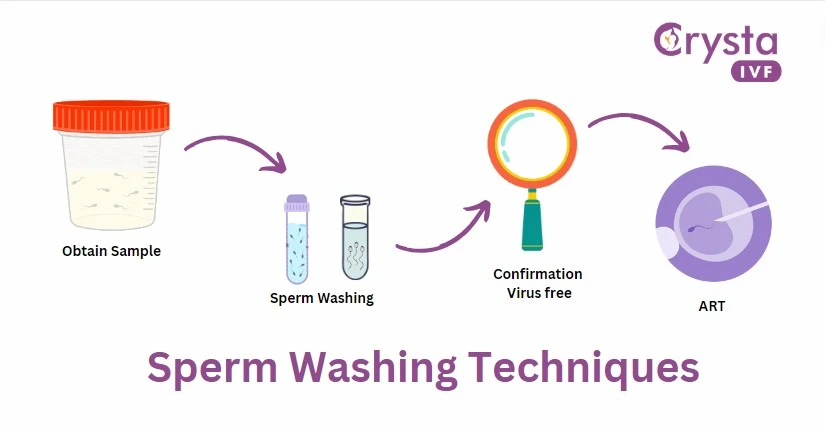
Due to this, the motile spermatozoa fraction is separated from the seminal plasma by sperm washing with the help of a culture medium for artificial insemination (AI).
You would be amazed to know that the sperm-washing process has evolved, and numerous methods for artificial insemination (AI) have made sure that you obtain good results in terms of count, motility, morphology, and DNA integrity that help sperm selection for inseminating techniques and elevate IVF success percentage.
After a brief introduction and going forward to the lean types of sperm wash techniques, let’s examine what you should consider while processing sperm samples for artificial or intrauterine insemination.
Learn: 9 Ways to boost male fertility and increase sperm count
Factors to keep in mind while processing sperm samples for IUI or AI
- Sperm washing should be carried out within 30 minutes of ejaculation, as enduring exposures to seminal plasma negatively influence the fertilizing ability of the spermatozoa in vitro.
- Dead spermatozoa and leukocytes in semen exert oxidative stress on healthy spermatozoa by releasing harmful reactive oxygen species (ROS) that lead to DNA damage.
- The appropriate protein-containing culture medium is necessary for sperm washing to facilitate the capacitation process.
After monitoring the factors to keep in mind, let’s analyze the types of sperm-washing techniques you need to know to start the process effectively.
Exploring Different Approaches to Sperm Washing: Advantages and Considerations
The commonly used sperm-washed techniques are as follows-
Simple Washing
This sperm-washing process involves diluting the semen twice. In some cases, more than the percentage of culture medium is included to allow the spermatozoa to settle down by applying a centrifugal force of not more than 800g (Juelinet al., 19821).
Advantages
- It is the simplest method of sperm preparation for IVF
- It uses the least amount of media and costs minimum.
Considerations
- Higher chances of the development of anti-sperm antibodies in IUI treatment cases.
- The plasma membrane and chromatin of the concentrated sperm-rich pellet are very susceptible to oxidative sperm damage.
- The dead abnormal spermatozoa and all semen components that can be pelleted by centrifugation are retained in the final preparation stage.
Sperm migration-based method
In vivo, the spermatozoa in the ejaculate naturally migrate towards the cervix and uterus after deposition near the cervical os. Likewise, spermatozoa migrate towards the layered culture medium in vitro. The “Swim Up” (SU) is a sperm wash technique in which motile spermatozoa swim towards and assemble in the medium culture phase after incubation for 15-16 minutes. Generally, it can be performed in two ways:
Direct swim-up: It is directly layered over or underneath (swim-down) the semen.
Swim-up from a washed pellet: The semen sample can be mixed with culture medium and centrifuged. The pellet is layered with more culture medium when the supernatant is removed.
Advantages
- High yield
- Less costly
- This benefit of sperm washing is that it uses less centrifugation, reducing centrifugation-related iatrogenic damage.
- The retrieved fraction is clean and rich in progressively motile sperm
Considerations
- The end swim-up is only segregated based on motility.
- Substances like prostatic zinc are diffused from the semen to the overlaid medium.
- The resultant pellet retains dead spermatozoa and leukocytes and leads to oxidative stress.
Specific density method
The density gradient centrifugation (DGC) method is one of the most crucial sperm-washing techniques. This method separates spermatozoa based on their specific gravity along a column of the change in quantity at their isopycnic point (the point where the density is the same as the gradient media) when applied with a centrifugal force.
A mature, morphologically normal sperm has a specific density of 1.12 g/ml, whereas the specified thickness of an immature, abnormal, or low sperm count is much lower than that. Centrifugation along the routinely used silane-coated silica particles of the 40% and 80% gradient allows the mature, morphologically normal spermatozoa to pierce the lower layer.
Advantages
- It takes less time than the swim-up method.
- This sperm-washing process gives a good yield for oligoasthenoteratozoospermia samples (OATs).
- It works to remove bacteria, debris, viruses, leukocytes, etc.
- This method of sperm preparation for IVF segregates spermatozoa based on functional maturity, DNA integrity, and morphology.
Considerations
- One of the more costly types of sperm-washing techniques
- The low outcome when compared to a swim-up method
- The centrifugation force is high and applied 2-3 times, elevating the risk of iatrogenic damage.
Microfluidic sperm sorter (QUALIS)
These small devices differentiate motile, morphologically normal spermatozoa from semen based on fluid dynamics in a microenvironment by guiding variables like fluid density, velocity, etc. This sperm-washing process reduces physical stress, removes debris, eliminates centrifugation, and minimizes DNA damage. Also, in this sperm wash technique, the required sample percentage is less, lessens the yield, and fails to be used in the IUI treatment.
Magnetic Activated Cell Sorting (MACS)
This sperm preparation for IVF separates apoptotic spermatozoa from non-apoptotic ones. As the cells undergoing apoptosis have phosphatidylserine residues on their membrane. This is a strong affinity for Annexin V conjugated to colloidal super magnetic beads that separate apoptotic cells when applied with a magnetic field.
This method is popularly used with DGC to maximize fertilization potential and embryo quality.
We must consider what fertility experts say now that we have studied various sperm-washing techniques and their benefits.
A Message From Crysta IVF!
Processing sperm samples for IUI or AI requires careful consideration of various factors to ensure optimal results. From assessing sperm quality to employing appropriate processing techniques and coordinating timing, each step is crucial in maximizing the chances of successful fertilization and pregnancy.
By adhering to best practices and individualizing the approach to each patient’s needs, healthcare professionals at Crysta IVF, the best IVF centre in Kolkata can significantly enhance the effectiveness of assisted reproduction techniques and bring positive outcomes to couples so they can start their parenthood journey without getting stressed.
Frequently Asked Questions
How long is washed sperm good for?
Washed sperm is generally found to be suitable for 6 to 12 hours. However, sometimes, it can last long as 24 to 48 Hours
Does sperm count boost up after washing?
After washing, there are between 10 million and 20 million sperm, with a motile sperm count of over 5 million and a motile sperm percentage of over 30%. The lowest sperm concentration necessary to conceive, in contrast, is 7 million, with a cycle pregnancy rate of 13.8%.
Does sperm washing improve morphology?
Yes, sperm washing does morphology.
Is washing sperm an effective technique?
Yes, sperm washing is a successful method for increasing sperm cell concentration.
